
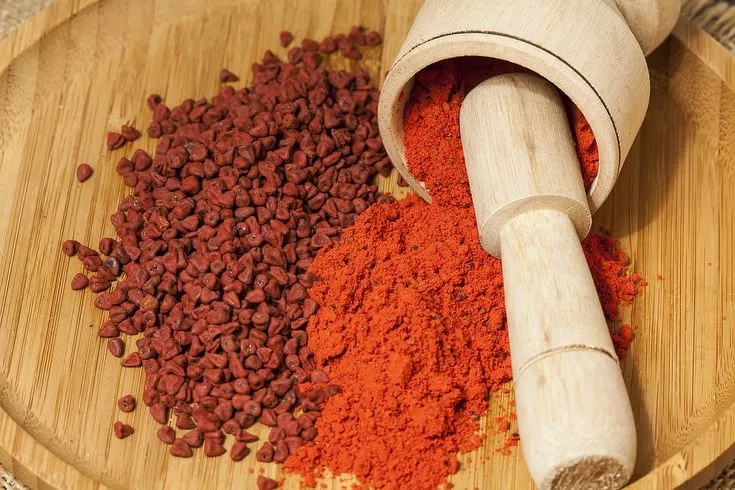
Color ingredients for food may be required to match the concept and technical specifications of the final product. Annatto is a natural source that can provide attractive yellow, golden and orange color in various categories of food. The possibilities for the use of Annatto Extract in the industry include formulations such as bakery products, dairy products, sauces, snacks, beverages, and others, for which warm natural hues can enhance the overall look.
What Is Annatto Extract?
The achiote plant is the source of Annatto and naturally has pigments that give it its yellow to orange color. Because of these pigments, annatto has become an interesting ingredient for the development of food colors.
The resulting shade may vary based on food matrix, extract, concentration and application. The full formulation can then be used to determine if there is a match between the formulation and the product.
Knowing the source and the range of color that is likely to be available helps the product developer as a starting point when applying it for testing.
Exploring Annatto Color Applications
Various food products where a yellow, golden or orange color is appropriate may be considered for use of annatto color. There are various possibilities to apply with dairy products, cheese-style products, sauces, snacks, bakery products, confectionery and selected beverages.
The optimum shade will be dependent upon the product concept. Sometimes a golden color is desired in a dairy product, but sometimes an orange color is desired in a snack or sauce. Manufacturers can fix their desired shade first and then check the concentrations for the best fit for their final product.
Match the Color with the Food Matrix
The properties of each formulation are different and may affect the appearance of a color once it is incorporated into the formulation. The final visual result can be influenced by moisture, fat content, acidity, texture and other ingredients.
Development teams can get a more realistic understanding of the performance of an annatto-based ingredient by testing it in the actual product. Small volume samples can be formulated in the way you desire and compared at various levels of application. This process can be helpful for the manufacturer to determine an appropriate concentration and to see if the color is evenly distributed across the product.
Consider Different Food Applications
Annatto may be used to produce warm colors for those products that benefit from a yellow or orange hue, such as for flavor and color. These shades might be applicable in foods such as dairy products, sauces, snacks, baked goods or other foods.
Manufacturers can determine the ingredient based on the unique needs of each application. The same color source can produce varying visual effects with different formulations. Application-specific testing enables the developer to determine the color strategy for the product and not just an expectation.
Evaluate Processing Conditions
Mixing, heating, cooling, baking, drying, freezing, etc. can be part of food production. These should be taken into account when developing color.
Manufacturers can replicate the critical processing steps at a small-scale to determine the behavior of the selected ingredient during the manufacturing process. This can be used to decide a proper stage and application method of addition.
Storage conditions can also be included in development testing. When observing the finished product during expected storage time, more information can be gained on the appearance of the product, and teams can refine the formulation.
Choose the Appropriate Ingredient Format
Color ingredients may come in a variety of different formats depending on the source and application. Depending on equipment, formulation, moisture content and incorporation methods wanted, manufacturers may choose liquid or powdered materials.
The format should be suitable to the current production process. Developers can be testing for ease-of-measure, mixing and dispersing the ingredient in the actual product. Technical information supplied by the ingredients supplier can also aid manufacturers to understand how to handle the ingredients and which format is best suited to the application.
Plan for Consistent Production
After it has been determined that a suitable ingredient and application level of annatto have been found, the manufacturer can record important details of the formulation. These can range from concentration, addition stage, mixing procedure, processing conditions and target shade.
Having a clear specification will help ensure that the same look is obtained in every batch made. They can also be useful in product development in the future if similar shades of yellow or orange are needed. A documented process makes it easier to reproduce the preferred result as production moves from development into regular manufacturing.
Conclusion
Annatto provides manufacturers with an interesting naturally derived option for creating warm yellow, golden, and orange shades across many food applications. Careful consideration of the food matrix, desired appearance, processing conditions, ingredient format, and concentration can help developers create a practical color formulation. If you are exploring annatto-based solutions for your next food product, visit foodrgb.com to discover suitable options and continue developing an attractive finished formulation.

More Stories
Breaking Bread: How Innovation is Spicing Up the Food & Beverage Industry
Future Sips: The Next Big Beverage Trends Revolutionizing Your Glass
The Rise of Adaptogenic Elixirs: How Ancient Remedies Are Shaking Up Modern Beverage Trends